
Published August 25, 2026 · 8 min read
Water in a Crawl Space: When It Becomes a Foundation Concern
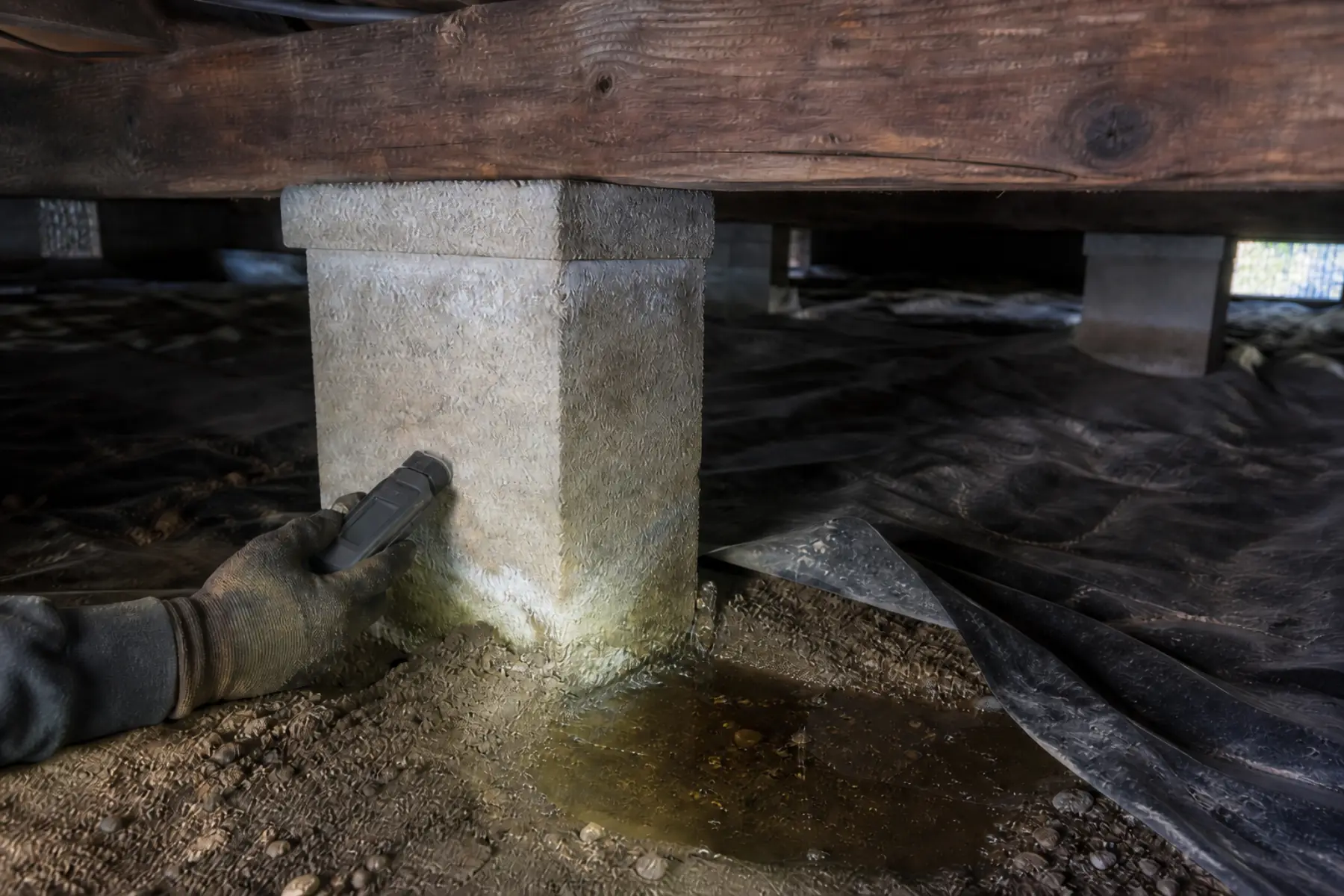
Standing water does not automatically mean foundation failure. The source, duration, and nearby structural symptoms determine what needs to be inspected.
Quick answer
Water in a crawl space becomes a foundation concern when it persists or returns, saturates soil around supports, accompanies a displaced or changing crack, contributes to wood decay or metal corrosion, or appears with measurable floor movement. Remove immediate safety hazards, identify the water source, and have structural symptoms evaluated before committing to a major foundation repair.
Is water in a crawl space a foundation problem?
Not every wet crawl space indicates foundation movement. A leaking supply line, a failed condensate drain, or a downspout that empties beside the house can produce water without changing the load-bearing system. The first task is to separate the moisture source from its structural consequences.
The issue becomes structural when water changes the soil supporting the foundation, deteriorates concrete or masonry, damages wood framing, corrodes connectors, or appears alongside displacement or measurable movement. Duration matters too. A one-time plumbing leak and water that returns after every storm require different investigations.
Floor elevations are useful, but they are not a complete pass-or-fail test. A house can show a limited elevation range while the accessible crawl space still contains standing water, saturated soil, damaged support elements, or a crack that needs further evaluation.
Start with the water source
Crawl space moisture problems are easier to diagnose when observations are tied to weather and building systems. Note whether the water appears after rain, during irrigation, while plumbing fixtures are in use, or during warm and humid weather. That timing narrows the likely source.
EPA moisture guidance and the Department of Energy's Building America Solution Center both place bulk-water control ahead of crawl space sealing or insulation work. Covering damp soil without correcting the entry path can hide the condition rather than resolve it.
- Roof runoff: clogged gutters, short downspouts, or roof areas that discharge onto a lower roof can concentrate water beside the foundation.
- Surface grading: soil, paving, or planter beds that slope toward the house can hold water against the perimeter.
- Underground drainage: a buried line may be blocked, damaged, or discharging too close to the building.
- Plumbing or equipment: supply, waste, irrigation, water-heater, and HVAC condensate leaks can wet a crawl space independently of rainfall.
- Groundwater and seepage: water may enter below the exterior grade or rise at a low point during prolonged wet weather.
- Ground vapor or condensation: damp soil and cool foundation surfaces can add moisture even when no puddle is visible.
Signs the moisture may be affecting the foundation
No single symptom proves that water caused structural damage. The concern rises when several observations occur in the same area or change over time. Photographs, dates, measurements, and prior repair records help an engineer distinguish an active condition from an old, stable one.
Crack direction alone is not a diagnosis. A horizontal foundation crack deserves attention, but its width, continuity, displacement, location, repair history, and surrounding material condition determine its significance. The same caution applies to vertical and stepped cracks.
- A foundation wall that is bowed, offset, displaced, or visibly deteriorating.
- A horizontal, stepped, or widening crack, especially when a prior repair has reopened.
- Concrete spalling, exposed reinforcing steel, or continuing material loss around a crack.
- Wood posts, beams, or floor framing that show decay, crushing, separation, or loss of support.
- Corroded or missing connectors at posts, piers, sill plates, or other load-path connections.
- Floors that have changed elevation, become noticeably uneven, or move differently from adjacent rooms.
- Standing water or saturated soil concentrated around footings, piers, or a settled corner.
Crawl space foundation damage signs (FEMA guidance)
Water is not the only hazard that shows up first in a crawl space. FEMA's earthquake and flood publications point to specific crawl space conditions that make a house more vulnerable, and they are worth checking from a safe vantage point before an engineer visits.
After the 2014 South Napa earthquake, FEMA reported that wood-frame homes with cripple walls (short wood walls between the foundation and the first floor) and inadequate anchorage to the foundation are vulnerable to earthquake damage, and that homes with cripple wall damage are usually identified as unsafe to occupy, or red tagged. FEMA's guidance on bolting sill plates describes a cripple wall and crawl space foundation as a type of construction especially susceptible to earthquake damage: if the sill plate is not securely anchored, shaking can make it slide with respect to the foundation.
For flooding, FEMA's mitigation handbook for public facilities groups crawl space foundations with other shallow foundations and notes that shallow foundations are vulnerable to moving floodwaters and can be undermined by scour and erosion. The same mechanism applies to residential footings when runoff repeatedly washes soil away from the perimeter.
- A wood sill plate with no visible anchor bolts or other connection to the top of the foundation wall.
- A sill plate or cripple wall that has shifted, separated, or leans relative to the foundation below it.
- Soil washed out, eroded, or missing beneath footings or piers after heavy runoff or flooding.
What white powder on concrete means
White powder on a concrete wall or pier is often efflorescence. Water dissolves salts within soil, concrete, mortar, or adjacent materials. As that moisture reaches the surface and evaporates, the salts remain as a white or crystalline deposit.
Efflorescence is evidence that moisture has moved through the material. It is not, by itself, proof that the concrete has lost structural capacity, and it should not be treated as a mold diagnosis. Its value is contextual: repeated deposits, damp surfaces, spalling, cracking, or corroded metal point to a moisture path that needs investigation.
Cleaning the powder may improve visibility, but it does not stop the water source. Document the condition before cleaning so future deposits can be compared against a clear baseline.
Who to call for water in a crawl space
The right professional depends on the immediate problem. CMZStudio evaluates structural conditions; it does not provide emergency water extraction, mold remediation, pest treatment, or general waterproofing. Starting with the correct discipline reduces the chance of paying for a system that does not address the source.
- Call an emergency water-removal or electrical professional when standing water creates an immediate access or electrical hazard. Do not enter an unsafe crawl space.
- Call a plumber or HVAC contractor when the timing points to a supply, waste, appliance, or condensate leak.
- Call a drainage or waterproofing contractor when the source is clearly exterior runoff, grading, or a failed drain and no structural distress is present.
- Call a licensed structural engineer when water appears with foundation cracks, displacement, deteriorated supports, framing damage, or measurable floor movement, or before accepting a major foundation-repair proposal.
- A geotechnical engineer may be needed when recurring groundwater, expansive soil, slope movement, or bearing conditions cannot be resolved through a visual structural inspection.
What a structural foundation inspection can answer
A foundation inspection should connect the homeowner's symptoms to the accessible load-bearing system and site conditions. It should also state what was not verified. Concealed reinforcing, footing dimensions, soil properties, subsurface drains, and waterproofing details often require records, testing, excavation, or another consultant.
- Whether visible cracks or movement appear localized or part of a broader pattern.
- Whether floor-level measurements support the reported symptoms and where additional monitoring is useful.
- Whether concrete, masonry, wood framing, posts, piers, and accessible connectors show deterioration or loss of support.
- How exterior drainage, irrigation, low points, and downspouts relate to the wet area.
- Which immediate maintenance steps are reasonable and which conditions need destructive testing, drainage evaluation, geotechnical input, or repair design.
What to document before the inspection
Good evidence shortens the diagnostic process. Do not enter a confined or flooded area that feels unsafe. From accessible locations, collect the history that shows when and where the condition occurs.
- Photograph the wet area, nearby foundation walls, supports, and exterior drainage after a rain event.
- Record whether the water is new, seasonal, or present throughout the year.
- Identify recent plumbing, roofing, grading, landscaping, drainage, or foundation work.
- Save prior inspection reports, repair invoices, floor surveys, and photographs of cracks before patching.
- Mark cracks with dates or repeat photographs from the same position rather than relying on memory.
Frequently asked questions
- Is water in a crawl space always a foundation problem?
- No. Water may come from plumbing, roof runoff, drainage, groundwater, ground vapor, or condensation without causing foundation movement. It becomes a structural concern when it affects supporting soil or materials, appears with displacement or changing cracks, or damages framing and connections.
- Who should I call for water in a crawl space?
- Call the professional matched to the source: emergency water removal for unsafe standing water, a plumber or HVAC contractor for an active leak, a drainage contractor for exterior runoff, and a structural engineer when cracks, movement, damaged supports, or a major repair proposal are involved.
- Can crawl space moisture cause foundation cracks?
- Moisture can change supporting soils and deteriorate building materials, but a crack does not prove a single cause. An engineer considers the crack pattern, displacement, floor measurements, drainage, soil context, repair history, and testing limitations before assigning structural significance.
- What is the white powder on a concrete foundation wall?
- It is often efflorescence, a deposit of soluble salts left after moisture reaches the surface and evaporates. Efflorescence shows a moisture path but does not by itself prove structural failure or identify the water source.
Official references
- US EPA — Moisture Control Guidance for Building Design, Construction and MaintenanceFederal guidance on site drainage, foundations, condensation, and controlling water movement through buildings.
- US EPA — Remodeling Your Home and Indoor Air QualityExplains why basement and crawl space moisture should be corrected before other remodeling work.
- DOE Building America — Pre-Retrofit Assessment of Crawlspaces and BasementsInspection guidance for standing water, roof drainage, grading, framing, utilities, and moisture sources.
- DOE Building America — Water Management of Existing Crawlspace FloorPlaces bulk-water and drainage corrections before crawl space sealing and insulation work.
- National Park Service — Assessing Cleaning and Water-Repellent Treatments for Historic MasonryDefines efflorescence as salts deposited when moisture reaches a masonry surface and evaporates.
- FEMA P-1024/RA2 — Earthquake Strengthening of Cripple Walls in Wood-Frame DwellingsReports that cripple walls with inadequate anchorage are vulnerable to earthquake damage and that damaged homes are often red tagged.
- FEMA — Bolt Sill Plates to FoundationDescribes cripple wall and crawl space foundations as especially susceptible to earthquake damage when sill plates are not anchored.
- FEMA P-2181 — Fact Sheet 3.1: FoundationsClassifies crawl space foundations as shallow foundations that moving floodwaters can undermine by scour and erosion.
- California BPELSG — Consumer Guide to Professional EngineeringOfficial state guidance on licensed engineering services for foundations, drainage, and residential buildings.

Lei Zheng
Founder & Principal Engineer, CMZStudio
California Professional Engineer
Licensed engineering from first calculation through plan check.
Lei Zheng has held a California Civil Engineer license since 2006. At CMZStudio, he reviews structural decisions, prepares and stamps engineering documents, and supports responses through city plan check.
Official California DCA record
C-69809
- License holder
- Lei Zheng
- License type
- Civil Engineer
- Issued
- March 17, 2006
Status verified July 23, 2026
- California-licensed
- 20 years
- Official DCA record
- C-69809